Filler words: useless phrases you can cut from your writing
 Words ought to mean something. Unfortunately, it’s easy to get into the habit of writing common words and phrases that add no meaning. These filler words only inflate the word count and decrease readability scores.
You may be familiar with Flesch-Kinkaid reading scores or the Gunning Fog Index. They examine the number of words in a sentence and the number of syllables in the words. Long sentences with long words are hard to read. Sometimes you need long sentences or long words to express your thoughts. But you don’t need filler words and phrases.
Readers will probably not be consciously aware of filler words in writing. After all, they are so commonplace. So writers need to be aware of them as they proofread and edit what they’ve written. Recognize weak, unnecessary words. And delete them without mercy.
“So the writer who breeds more words than he needs is making a chore for the reader who reads.” ― Dr. Seuss
Very
Mark Twain suggested, “Substitute ‘damn’ every time you’re inclined to write ‘very’; your editor will delete it and the writing will be just as it should be.”
Except nowadays, editors probably won’t delete “damn”—if a publisher still has editors at all. And if you publish on your own website, you have to be your own editor. So here’s a less colorful but more contemporary way to express Twain’s advice: Seek and destroy “very.”
People who use it are trying to intensify whatever word it modifies. Instead, substitute a stronger word. Instead of a very loud sound, how about a deafening roar?
Just
“Just” has all kinds of legitimate uses. You can write about a just cause, for example.
But don’t you just hate it when people sprinkle their writing or speech with “just” when it adds no meaning? You should just leave it out in that case. It’s just a filler word that bogs down your writing. (It annoys lots of people in speaking, too.)
Adverbs
Many writing teachers advocate avoiding adverbs entirely. That advice is too extreme. We have adverbs in the English language because we need to use them from time to time. If I simply cut “entirely” from the first sentence in this paragraph, it would cut some meaning.
But like “just” in the previous section, adverbs can often be mere filler words better omitted. Or like “very,” a reminder to look for a stronger verb that doesn’t need modification.
Redundancies

Filler words in writing can kill it as surely as plastic filled and killed this albatross. Some rights reserved by Sea Studios Foundation
Why would anyone say the same thing twice in the same sentence?
But lots of people do. Consider the following filler words in writing:
- Absolutely essential
- Actual facts
- Added bonus
- Assemble together
- Bald headed
- Basic necessities
- Close proximity
- Completely [followed by just about any other word]
- Current trend
- Eliminate altogether
Need I continue through the alphabet? When two words mean the same thing, you don’t need both of them. If you want more, someone collected 298 filler words, including a lot of redundancies. But no list can capture every redundancy.
Hunt them down. Be a ruthless editor.
Empty phrases
Needless to say, you can tighten your writing by cutting out empty phrases, such as:
- needless to say
- as a matter of fact
- at the present time
- for all practical purposes
- in terms of
- in the event that
- for the most part
- for the purpose of
Nominalizations
Nominalizations are words derived from verbs or adjectives. Intention comes from intend. Collection comes from collect. Difficulty comes from difficult.
You can often strengthen your sentence by using the verb or adjective instead of the noun.
Why instruct to give an analysis and make a summary when you can use analyze and summarize? Why say something caused confusion instead of that it confused?
Expletives
Publication of Richard Nixon’s secret tapes popularized the phrase “expletive deleted” when someone spoke in unprintable word. But “expletive” doesn’t mean foul language. It means a kind of filler word.
You can recognize expletives by looking for words such as here, there, or it as the subject of a sentence and a form of to be as the verb.
There is often a better way of expressing a thought without using the expletive “there is.” Um, writers can often find a better way . . .
But I have one caveat:
The English language has expletives, adverbs, nominalizations, the verb to be, passive voice, and other targets for an editor’s red ink because they can serve a useful purpose.
When you find any of these fillers as you edit, try to find a better way of expressing your thought. But there might not be one!
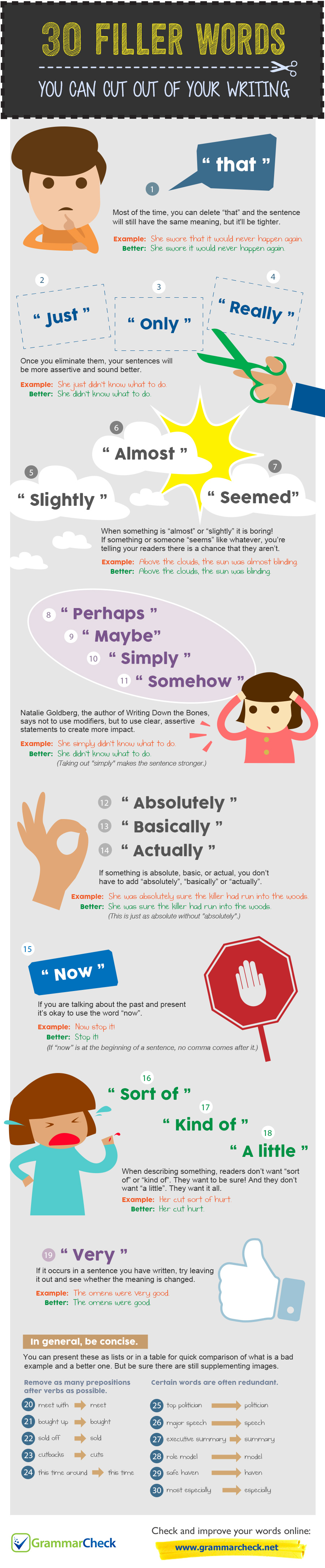
Source: www.grammarcheck.net
Comments
Filler words: useless phrases you can cut from your writing — No Comments
HTML tags allowed in your comment: <a href="" title=""> <abbr title=""> <acronym title=""> <b> <blockquote cite=""> <cite> <code> <del datetime=""> <em> <i> <q cite=""> <s> <strike> <strong>