Social media and the evolution of information literacy
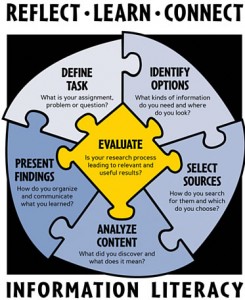 “Information literacy” is a term most often associated with academic libraries. Sometime in the 1980s, it began to replace the older “bibliographic instruction.” By whatever name, showing people how to use the library has long been one of the librarians’ core duties in any kind of library. Social media and search engines have made it more important and more complicated than ever.
The 1920s make a convenient starting point for examining information literacy. Before then, libraries, including academic libraries, had fairly small collections. Library buildings existed primarily for the sake of the reading experience.
But as collections grew, libraries had to dedicate more and more space to house them. What’s more, it became more difficult for readers to identify what to read. The larger academic libraries began to see bibliographic instruction as a necessary part of their services. That is, they taught students how to use the collection.
For decades after that, library collections comprised mainly books and journals. But then they started to add films, recordings, and other non-print materials. And after that, computers began to take over such important library services as the catalog.
From bibliographic instruction to information literacy

A small portion of a visualization of the New York Public Library’s digital collection.
By about 1970, academic libraries started to become dissatisfied with bibliographic instruction based on the collection. Instead, they developed the idea of the teaching library. The concept of more curriculum-centered instruction, information literacy, made librarians collaborators with the teaching faculty.
Where bibliographic instruction started at the largest universities, information literacy came from libraries at smaller institutions that considered themselves more teaching universities than research universities. “Lifelong learning” became a key component of developing information literacy skills.
Patricia Senn Breivik, a strong advocate of the teaching library, wrote, “What is the value of good collections if most students cannot or will not use them?” She conceived of reference librarians with expertise that matched curriculum areas. That is, libraries would hire a business librarian, a science librarian, and other specialties.
Academic libraries began to create classrooms especially for library instruction. At the same time, they started such other innovations as study rooms and collaborative learning areas. They abandoned the traditional insistence on silence and opened areas for conversation.
Then came computers.
Computers and information literacy
 At the Library of Congress, Henriette Avram led a team that developed the MARC standard (MAchine Readable Cataloging.) They introduced the pilot program in 1968. Among other innovations, it allowed libraries to see what other libraries owned without purchasing expensive and cumbersome union catalogs. By the end of the 20th century, the online catalog had replaced the card catalog.
The World Wide Web came along in 1989. After the introduction of a truly useful web browser, it caught on quickly with the public. At about the same time, the term “information literacy” began to eclipse “bibliographic instruction.”
Remarkably quickly, some visionaries began to proclaim the death of the library. In fact, I know of one case in the mid-1990s where a dean was named interim director, although he had no library experience. The librarians had to scramble to prevent him from canceling all the journal subscriptions. He thought that all information would soon move to computers! (It still hasn’t, by the way.)
Further development of the concepts of information literacy and the teaching library became important strategies for the library to maintain its reputation with the faculty. Controversy remains over how best to offer information literacy instruction or even whether to call it by that name. But specialist librarians remain important liaisons and advocates for the library.
The advent of algorithms
 Nowadays, advancing technology has only added to the burden of information literacy. The growth of Google, Amazon, and social media has transformed information and information seeking. These platforms depend on algorithms.
In simplest terms, an algorithm is a set of guidelines that describe how to do something. By that definition, recipes in cookbooks are algorithms. More specifically, programmers write algorithms to tell computers what to do.
In building a search engine or social media platform, programmers must anticipate what millions of people will want to do with them. So they have turned to artificial intelligence and machine learning.
The machines have learned to figure out what individuals search for and then put more of whatever that is in front of them. In particular, they dole out advertisements, news sources, and other information based on these individual preferences.
Two people performing the same search will not necessarily get the same results. And two people viewing the same web page will not see the same advertising. One consequence, therefore, has been social divisions wherein people read only news that they’re likely to agree with already.
Social media uses algorithms to feed some people news from the “orange network” and other people the “purple network.” People in each group consider people in the other uninformed or misinformed and start complaining about fake news.
All the while, since we can’t actually see algorithms at work, most of us don’t think about them at all. Many people may not even be aware that a team of programmers stands between them and their search results. In any case, since the algorithms are proprietary, the public can’t know what assumptions the programmers have built into them.
I’ll not even try to describe how these companies soak up personal data from internet-connected gadgets including baby monitors and voice-activated assistants.
Algorithms, crooks, and information literacy instruction
The new age of algorithms has enabled us to find information in seconds that might have taken hours or months to find before. It lets us stay in touch with people who live far from us. We can easily make relationships with people whom we wouldn’t otherwise have an opportunity to meet. But these advantages come at a cost that no one yet knows how to compute.
Students and faculty have become equals in their difficulty navigating and understanding these fundamental changes.
And with any technology, dishonest people will eventually abuse it. Quite beyond questions of social media data collection and fake news, some hackers use the internet to steal identities. Others use it to try to steal elections. To say it’s a jungle out there maligns innocent beasts. The profession of librarianship is forced to play a role in protecting the public.
Information literacy is the discipline in the best position to help us sort everything out. But will it?
It appears that when it comes to evaluating information, only 11% of students turn to librarians, while 61% turn to friends and family. Information literacy instructors will have to find a way to help the entire community deal with the glut of information, misinformation, and disinformation beyond traditional scholarship. And induce the community to turn to them for help.
Sources:
How we got here / Susan Ariew, Communications in Information Literacy. 2014
Information literacy in the age of algorithms / Alison J. Head, Barbara Fister, and Margy MacMillan. Project Information Literacy: January 15, 2020
Comments
Social media and the evolution of information literacy — No Comments
HTML tags allowed in your comment: <a href="" title=""> <abbr title=""> <acronym title=""> <b> <blockquote cite=""> <cite> <code> <del datetime=""> <em> <i> <q cite=""> <s> <strike> <strong>